Short answer: A bank (or other direct lender) offers its own loan products through its own loan officers, while a mortgage broker works with multiple lenders and shops your application among them. Neither is always cheaper: the CFPB notes both are paid a loan-specific fee or commission by you or the lender, and federal law bars that pay from varying with your loan's terms. The best move is to compare official Loan Estimates from more than one source on the same day.
Scott Smolen is a local Realtor helping buyers and sellers in Crofton, Odenton, Gambrills, Bowie, Severn and the Fort Meade area. One of the first questions buyers ask us is whether to go to their bank or use a mortgage broker. With Freddie Mac's 30-year average at 7.24% (October 29, 2026), shopping carefully matters more than it has in years. Here is how the two compare, how each gets paid, and what a small rate difference is worth.
What is the difference between a mortgage broker and a bank?
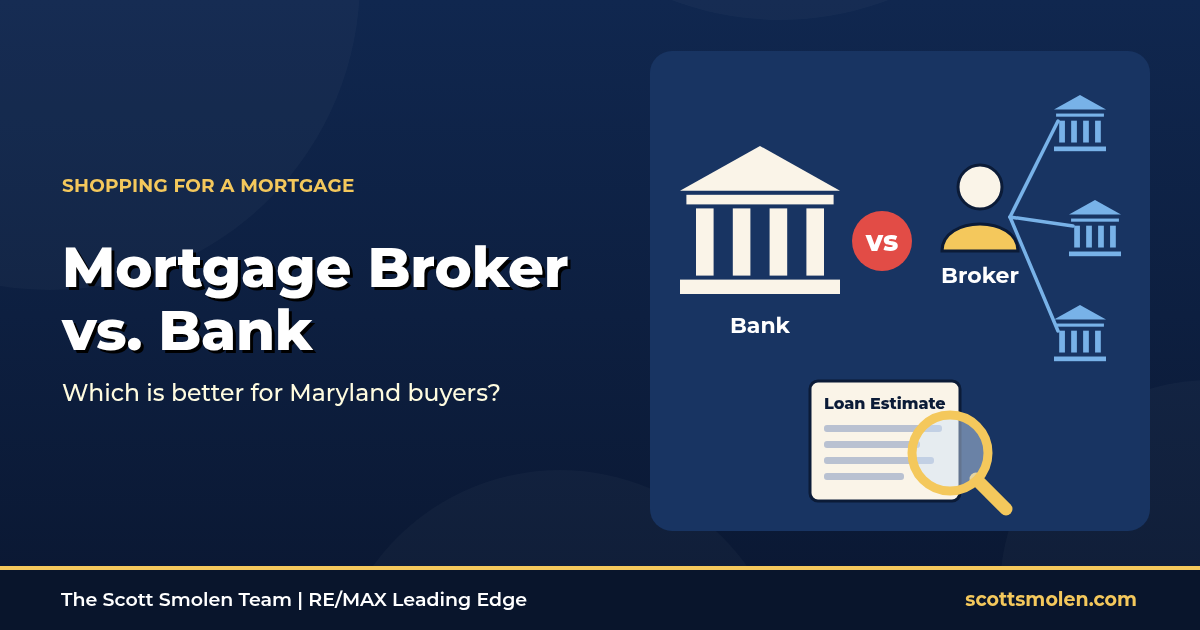
According to the CFPB, mortgage loan officers often work for one specific lender, and mortgage brokers typically work with multiple lenders. A bank's loan officer can only offer that bank's programs and pricing. A broker takes one application and compares offers from several wholesale lenders, then the chosen lender funds the loan.
| Feature | Mortgage broker | Bank or direct lender |
|---|---|---|
| Whose loans | Several lenders' programs | Its own programs only |
| Who funds the loan | The lender the broker places you with | The bank itself |
| How the loan officer is paid | A loan-specific fee or commission, paid by you or the lender | Salary, per-loan pay or a mix, set by the lender |
| Rate shopping | Broker compares lenders for you | You shop other lenders yourself |
| Relationship perks | Usually none tied to deposits | May offer discounts for existing customers; ask |
| Control over underwriting and closing | Shared with the funding lender | In-house |
| VA, FHA and conventional loans | Depends on the lenders the broker works with | Depends on the bank's programs |
Credit unions and non-bank mortgage companies are direct lenders too. See our older guide, Credit Unions vs. Banks for Mortgages, and What Is a Mortgage Broker?
How do mortgage brokers and bank loan officers get paid?
The CFPB explains that the person who arranges your mortgage is usually paid a loan-specific fee or commission, paid by you or by the lender. Federal law prohibits that commission from varying based on the terms of your mortgage, though lenders can pay a salary, a fixed amount per loan, a percentage of the loan amount or a combination.
There is one more protection worth knowing. Under the CFPB's loan originator compensation rule, if you pay a loan originator directly for your loan, no loan originator may also receive compensation from another party for that same transaction. Before you apply, ask every broker or loan officer: "How are you paid on my loan, and who pays you?"
What are the pros and cons of a mortgage broker vs. a bank?
Mortgage broker
Pros: one application, many lenders; may find a better rate or a niche program; helpful if your credit, income or property is less typical; does the comparison work for you.
Cons: broker compensation is built into the price, either as a fee or in the rate; less direct control over the lender's underwriting timeline; quality varies, so check the broker's license and reviews.
Bank or direct lender
Pros: underwriting and closing handled in-house; possible discounts for existing customers; one point of contact from application to closing.
Cons: only one menu of loan programs and prices; you have to do your own shopping; may not be the most competitive on a given day.
What does a 0.25% rate difference cost?
Here is why shopping matters. Take an Anne Arundel County purchase at the September 2026 median sales price of $503,000 (Maryland REALTORS) with 20% down, for a $402,400 loan. Compare Freddie Mac's 30-year average of 7.24% with a quote 0.25 point lower at 6.99%. The 6.99% figure is a hypothetical example of what shopping might find, not a quoted rate.
| Rate | Monthly P&I | Difference per month | Difference over 5 years |
|---|---|---|---|
| 7.24% (Freddie Mac average, Oct. 29, 2026) | $2,742.35 | - | - |
| 6.99% (hypothetical quote 0.25 point lower) | $2,674.48 | $67.87 | $4,072.20 |
The math: Monthly payment = Loan x r / (1 - (1 + r)^-n), n = 360.
At 7.24%: r = 0.0060333; payment = $2,742.35. At 6.99%: r = 0.0058250; payment = $2,674.48.
Savings: $2,742.35 - $2,674.48 = $67.87 a month, or $67.87 x 60 = $4,072.20 over five years.
That savings only counts if the lower rate does not come with higher points or fees. That is why you compare the full Loan Estimate, not a quoted rate. Where rates may go next is covered in our 2026 Maryland mortgage rate outlook, and why a Fed move does not set your rate is in The Fed Raised Rates: Does That Mean Mortgage Rates Are Going Up?
How do you compare a broker's offer with a bank's?
- Get Loan Estimates on the same day for the same loan amount, term and lock period.
- Check page 1 and page 3. The CFPB notes the interest rate is on page 1 under "Loan Terms" and the APR is on page 3 under "Comparisons." The APR reflects the rate plus points, mortgage broker fees and other charges.
- Compare points and lender credits on page 2 of the Loan Estimate, and ask how each option changes your cash to close.
- Verify licensing. Look up any broker, lender or loan officer on NMLS Consumer Access before you share documents.
- Ask about timelines. In a competitive Crofton or Odenton offer, a lender that can close on time and communicate with the listing agent can matter as much as the rate.
Which is better for a VA loan near Fort Meade?
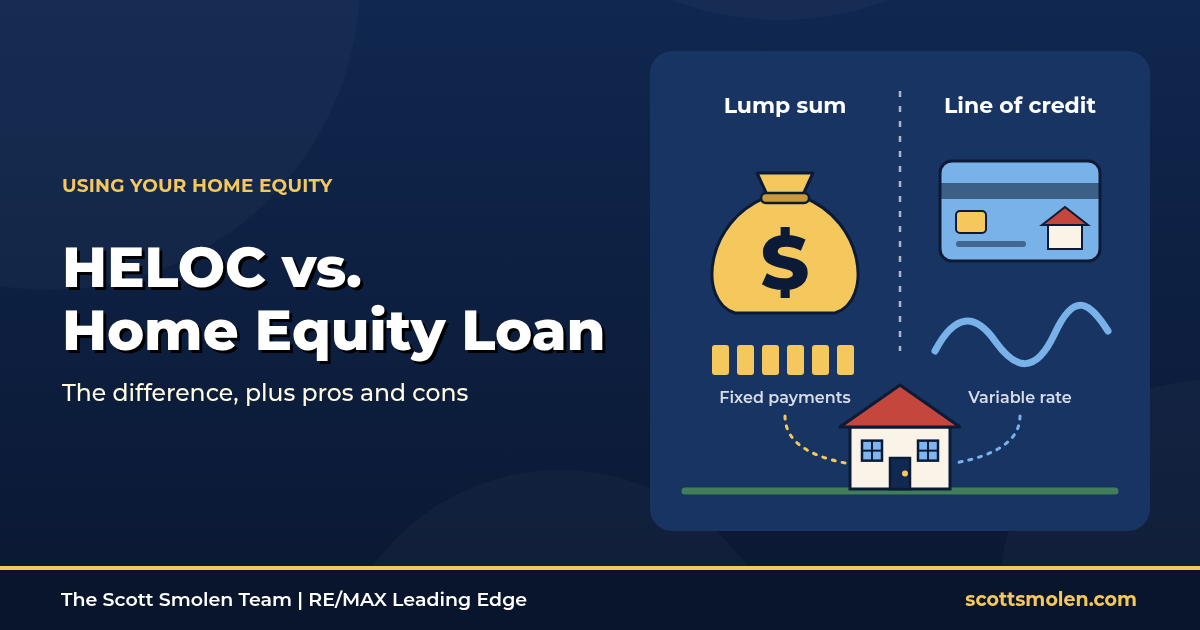
Either can work. What matters is whether the loan officer closes VA loans often and understands PCS timelines, entitlement and the VA appraisal process. Ask a broker which VA lenders they place loans with, and ask a bank whether it offers VA loans directly. Then compare VA and conventional Loan Estimates side by side. Current homeowners comparing ways to tap equity can read HELOC vs. Home Equity Loan, and owners 62 and older can review reverse mortgage pros and cons. Sellers weighing what buyers can afford should see What Higher Mortgage Rates Mean for Maryland Home Sellers.
Frequently asked questions
What is the difference between a mortgage broker and a bank?
A bank lends through its own loan officers and offers only its own programs. A mortgage broker typically works with multiple lenders, compares their offers for you and places your loan with the lender that funds it.
Is a mortgage broker cheaper than a bank?
Not always. Both are paid a loan-specific fee or commission by you or the lender, and federal law bars that pay from varying with your loan's terms. Compare full Loan Estimates from each on the same day to see which is cheaper for you.
How much can a lower mortgage rate save?
On a $402,400, 30-year loan, 7.24% costs about $2,742.35 a month in principal and interest and 6.99% costs about $2,674.48, a difference of about $67.87 a month or $4,072 over five years, if fees are the same.
Can a mortgage broker be paid by both me and the lender?
No. Under the CFPB's loan originator compensation rule, if you pay a loan originator directly for your loan, no loan originator may also receive compensation from another party for the same transaction.
Should I use a broker or a bank for a VA loan near Fort Meade?
Either can work. Choose a loan officer who closes VA loans often and understands PCS timelines, then compare VA and conventional Loan Estimates side by side.
What should I compare on a Loan Estimate?
Compare the interest rate on page 1, the APR on page 3, points and lender credits, total closing costs and cash to close, using quotes from the same day for the same loan.
Talk to a local lender before you decide
The right fit depends on your credit, down payment, loan type and closing timeline, and many buyers end up comparing one broker and one bank. Call The Scott Smolen Team at 301-651-1261.
The Scott Smolen Team at RE/MAX Leading Edge, 1655 Crofton Blvd, Suite 203, Crofton, MD 21114.
Disclaimer: This article is general information, not financial, tax or legal advice, and it is not a loan offer or rate quote. The 6.99% rate is a hypothetical example. Mortgage rates are Freddie Mac PMMS weekly averages as of October 29, 2026; Freddie Mac publishes new averages every Thursday. The Scott Smolen Team does not originate loans; confirm rates, fees, licensing and eligibility with a licensed mortgage lender or broker.
Sources:
- CFPB, How does a mortgage loan officer or broker get paid?: View official source (accessed October 19, 2026)
- CFPB, Final rule: Loan Originator Compensation Requirements under the Truth in Lending Act (Regulation Z), January 2013 (PDF): View official source (accessed October 19, 2026)
- CFPB, What is the difference between a mortgage interest rate and an APR?: View official source (accessed October 19, 2026)
- Freddie Mac, Primary Mortgage Market Survey, U.S. weekly averages as of October 29, 2026: View official source (accessed October 29, 2026)
- Maryland REALTORS, Housing Statistics: September 2026 (Bright MLS data): View official source (accessed October 19, 2026)
- CFPB, How do mortgage lenders calculate monthly payments?: View official source (accessed October 19, 2026)